



GDPR-compliant chat data export is the process of delivering a user's personal chat information in a structured, machine-readable format within a legally mandated timeframe. Under GDPR Article 20, data controllers must respond to data portability requests within 30 days, using formats such as JSON or CSV. That deadline applies to Subject Access Requests (SARs) across both EU and UK GDPR as of 2026. For data privacy professionals and business owners, getting this right means more than clicking an export button. It means building a verified, auditable process that holds up under regulatory scrutiny.
What formats and methods cover GDPR compliant chat data export?
Most major chat platforms deliver exports through automated account settings, but the technical details vary significantly. Common formats include JSON, CSV, ZIP archives, and HTML files. Each format serves a different downstream use: JSON preserves structure for programmatic processing, CSV works for spreadsheet analysis, and HTML is readable but harder to parse automatically.

OpenAI provides a full data export via email as a ZIP file containing both JSON and HTML versions of conversation history. The download link expires after 24 hours, and processing can take anywhere from a few minutes to 7 days depending on account size. That expiration window matters. If your compliance workflow involves forwarding exports to data subjects, you need to account for that tight delivery window.
Processing times and metadata availability differ across platforms:
- Format: JSON, CSV, ZIP, or HTML depending on the platform
- Processing time: Minutes to 7 days; download links expire after 24 hours in most cases
- Metadata: Conversation timestamps and message IDs are typically included; IP logs and device data are often excluded
- Mobile constraints: Some platforms restrict full export to desktop or web interfaces only
- Jurisdiction: GDPR applies to EU/EEA residents regardless of where the platform is headquartered
One practical gap worth knowing: HTML exports are human-readable but do not satisfy the "machine-readable" standard under GDPR Article 20. If a user requests portability specifically, JSON or CSV is the correct format to provide. Offering only HTML may expose you to a compliance challenge.
Pro Tip: Always test your export workflow end-to-end before a real SAR arrives. Download the file, verify the format, check that timestamps and identifiers are present, and confirm the link reaches the recipient before it expires.
How do data retention and training opt-outs affect compliant exports?
Data retention and model training are two separate issues, but they interact in ways that catch many organizations off guard. Consumer-grade chat interfaces generally do not meet GDPR compliance for client data processing without enterprise tiers, Data Processing Agreements (DPAs), and zero-data-retention configurations. That means if your team uses a standard consumer plan to handle client conversations, you are likely operating outside GDPR requirements.
The training opt-out problem is more subtle. Users must manually toggle opt-out settings to exclude their chat data from AI model training on consumer plans. Default behavior includes data retention for training purposes. Paid consumer tiers do not automatically improve privacy. That is a critical distinction: paying more does not mean your data is protected by default.
Key points on retention and deletion:
- Article 17 (Right to Erasure) and Article 20 (Data Portability) are separate rights. A user can request both simultaneously.
- Deleted data is typically purged within 30 days, but this varies by platform and does not always cover backups or logs.
- Zero-retention API settings prevent data from being used in model training but do not relieve the data controller from local governance and deletion responsibilities.
- Enterprise plans with DPAs offer contractual guarantees that consumer plans do not.
Pro Tip: After submitting a deletion request, follow up with a second SAR 35 days later. If data still appears in the export, the deletion pipeline has a gap. Document both requests and both responses for your compliance records.
What compliance steps do businesses need for GDPR chat data exports?
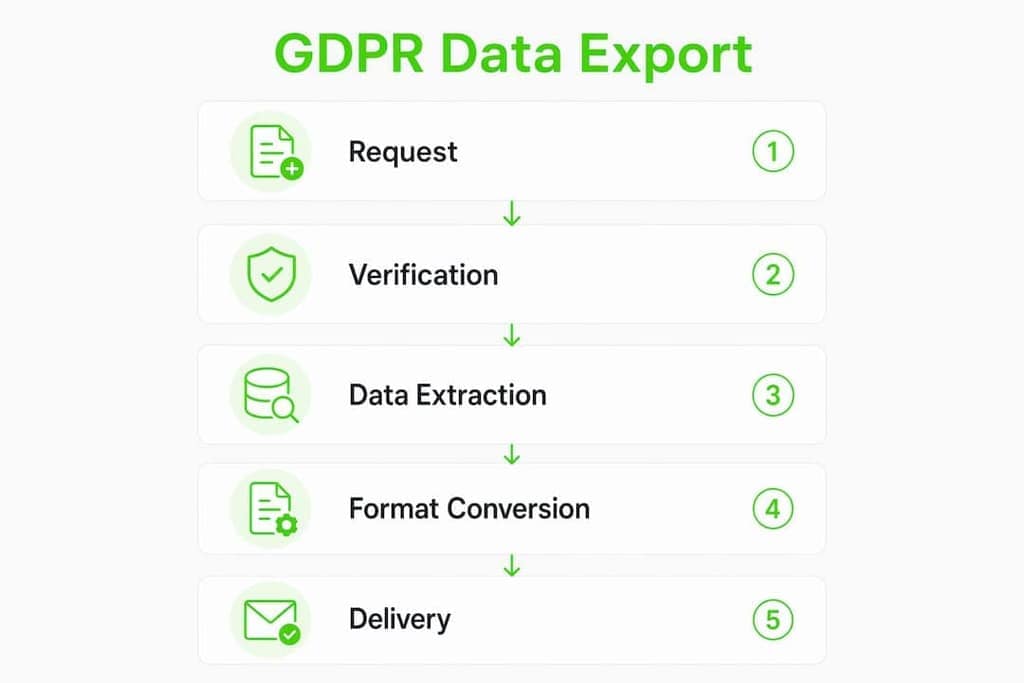
Building a compliant export workflow requires more than platform settings. It requires documented processes, tested procedures, and clear legal agreements. Here is the sequence that holds up under regulatory review:
Document your Records of Processing Activities (ROPA). ROPA documentation is the first document supervisory authorities request in a GDPR investigation. Your ROPA must include what chat data you collect, the legal basis for processing it, retention periods, and who has access.
Establish a Data Processing Agreement with every chat platform you use. A DPA is a contractual requirement when a third party processes personal data on your behalf. Without one, you cannot lawfully use a chat platform for client data under GDPR.
Map your full data footprint. Organizations must locate, export, and delete a user's entire data footprint to comply with GDPR's erasure and portability rights. That includes primary databases, backups, logs, and any SaaS integrations that received or stored chat data.
Test export and deletion procedures before going live. A critical compliance failure is not testing these procedures before deployment. If you cannot demonstrate a working export and erasure process during a regulatory review, the fact that you intended to comply carries no weight.
Secure the export in transit. Exports containing personal data must be encrypted during transfer. Sending a ZIP file over unencrypted email is not acceptable. Use secure file transfer protocols or password-protected archives with separately communicated credentials.
Preserve audit logs. Deletion flows must cover databases, backups, logs, and SaaS integrations while preserving the audit logs themselves. Deleting your audit trail to "fully erase" data creates a different compliance problem.
Pro Tip: Create a timestamped export log for every SAR you process. Record the request date, the export date, the format delivered, and the method of delivery. This log is your evidence of compliance if a supervisory authority asks.
What challenges arise with international data transfers during chat exports?
Cross-border data flows add a layer of complexity that many organizations underestimate. GDPR Chapter V restricts transferring personal data outside the European Economic Area unless specific conditions are met. Those conditions include adequacy decisions, Standard Contractual Clauses (SCCs), or Binding Corporate Rules (BCRs).
The practical challenge is enforcement. When chat data sits on servers in a non-EEA jurisdiction, your ability to compel deletion or verify export completeness depends entirely on your contractual relationship with that provider. Enforcement against platforms headquartered in jurisdictions like China is particularly difficult. Regulatory authorities have limited reach, and contractual remedies may be unenforceable in practice.
Recommendations for managing international transfers:
- Verify whether your chat platform has an adequacy decision or relies on SCCs for EEA data transfers.
- Request a copy of the SCCs from your provider and review the data importer obligations before signing a DPA.
- Maintain a local archive copy of all exported chat data before initiating deletion requests with non-EEA providers. If deletion cannot be verified, you have the local copy as a fallback.
- For high-risk transfers, conduct a Transfer Impact Assessment (TIA) to evaluate whether the destination country's laws undermine the protections in your SCCs.
- Prefer providers with EEA-based data residency options when handling sensitive client conversations.
The European Data Protection Board (EDPB) publishes updated guidance on transfer mechanisms. Checking that guidance annually is not optional for organizations with cross-border data flows. The regulatory landscape shifts, and SCCs that were sufficient last year may require supplementary measures this year.
Key Takeaways
GDPR-compliant chat data export requires structured formats, tested deletion pipelines, documented legal agreements, and verified cross-border transfer mechanisms working together.
| Point | Details |
|---|---|
| Legal format requirement | GDPR Article 20 mandates JSON or CSV; HTML alone does not satisfy machine-readable portability. |
| 30-day SAR deadline | Data controllers must respond to Subject Access Requests within 30 days under EU and UK GDPR. |
| Consumer plans are not compliant by default | Enterprise tiers with DPAs and zero-retention settings are required for lawful client data processing. |
| Test before you go live | Export and erasure procedures must be demonstrated to work before a regulatory review, not after. |
| International transfers need SCCs | Data leaving the EEA requires adequacy decisions or Standard Contractual Clauses to remain lawful. |
Why I think most organizations are one SAR away from a compliance gap
The organizations I see struggling most with GDPR chat data export are not the ones ignoring the rules. They are the ones who assumed their platform handled compliance for them. That assumption is the real risk.
Privacy settings are rarely defaulted to privacy-first. Organizations must actively manage DPAs and technical configurations rather than rely solely on provider policies. I have seen teams with enterprise contracts who never verified whether their DPA actually covered the specific chat product they were using. The contract existed. The coverage did not.
The other pattern I keep seeing is treating export and deletion as a one-time setup task. In practice, platforms update their data architectures, add new logging systems, and change retention defaults. A deletion pipeline that worked correctly in january may miss a new backup tier added in april. You need to re-test these flows at least quarterly, not just at launch.
My honest recommendation: build your compliance posture around what you can verify, not what a vendor claims. Pull a test export. Submit a test deletion. Wait 35 days and pull another export. If data persists, you have found a gap before a regulator did. That is the only way to know your GDPR data handling process actually works.
Elias
How Mastros fits into your chat data export workflow

Mastros builds browser-based Chrome extensions for exporting chat data from Telegram and WhatsApp without routing your data through external servers. Both extensions run entirely in your browser, which means your data never leaves your device during the export process. That architecture directly supports the data minimization principle under GDPR.
The Telegram and WhatsApp scrapers export group members, chat messages, and recent contacts to CSV, JSON, or JSONL. Those are the machine-readable formats that satisfy GDPR Article 20 portability requirements. For privacy professionals who need to pull community or contact data for compliance audits, research, or data subject requests, Mastros gives you a clean, local export without third-party data handling in the middle.
FAQ
What is GDPR-compliant chat data export?
GDPR-compliant chat data export is the delivery of a user's personal chat data in a structured, machine-readable format such as JSON or CSV, within 30 days of a Subject Access Request, as required by GDPR Article 20.
Does HTML format satisfy GDPR data portability requirements?
No. GDPR Article 20 requires a machine-readable format. HTML is human-readable but not machine-readable, so JSON or CSV is the correct format for portability requests.
Do consumer chat plans comply with GDPR for business use?
Consumer-grade chat plans generally do not meet GDPR requirements for processing client data. Enterprise tiers with Data Processing Agreements and zero-data-retention configurations are required for lawful business use.
How long does a platform have to delete chat data after a request?
Deleted data is typically purged within 30 days, but this timeline varies by platform and may not cover backups, logs, or third-party integrations without a verified deletion pipeline.
What is required to transfer exported chat data outside the EEA?
Transferring personal data outside the European Economic Area requires either an adequacy decision from the European Commission or Standard Contractual Clauses between the data controller and the receiving party, as governed by GDPR Chapter V.