



Telegram scraping is defined as the automated or manual extraction of data from publicly accessible Telegram groups, channels, or member lists. Browser tools such as the Mastros Telegram extension export group members and chat messages from Telegram Web to CSV, JSON or JSONL. Under US and EU law, accessing public data without bypassing authentication is generally legal, as confirmed by landmark rulings like hiQ Labs v. LinkedIn and Meta v. Bright Data. The question of whether Telegram data scraping legality holds up in practice depends on three factors: what data you collect, how you collect it, and what you do with it afterward. GDPR, the Computer Fraud and Abuse Act (CFAA), and Telegram's own anti-spam engine each add a distinct layer of risk you need to understand before you pull a single record.
Is Telegram scraping legal under US and EU law?
The legal framework for Telegram scraping rests on two pillars: US case law and EU privacy regulation. They point in different directions, and you need both to understand your actual exposure.
On the US side, federal courts have consistently held that scraping publicly accessible data does not violate the CFAA, because no unauthorized access occurs when data is open to anyone. The 2022 hiQ v. LinkedIn and 2024 Meta v. Bright Data rulings both affirmed this position. That means scraping a public Telegram channel without logging in sits in legally defensible territory under US law.

The CFAA line shifts the moment you bypass authentication. Logging into an account you don't own, or using technical methods to circumvent access controls, converts a legal act into a potential federal offense. Terms of Service violations alone do not create criminal liability, but they can support breach of contract claims and raise CFAA risk when combined with technical barriers. Staying logged out is the cleaner legal position.
The EU picture is more demanding. Key legal obligations include:
- GDPR lawful basis. Collecting personal data without a valid legal ground is illegal. Penalties reach €20 million or 4% of global annual turnover, whichever is higher. That is not a theoretical fine.
- EDPB Opinion 28/2024. The European Data Protection Board issued specific guidance on scraping personal data for AI training. It requires a three-step necessity test and documented mitigation measures.
- EU AI Act. Organizations using scraped Telegram data to train AI models face additional compliance obligations under the AI Act, including data minimization and transparency requirements.
- UAE PDPL. The UAE Personal Data Protection Law mirrors GDPR in key areas, including consent requirements and cross-border transfer restrictions. If your audience includes UAE users, PDPL applies.
Regional enforcement varies, but the direction is consistent: privacy regulators are tightening their grip on automated data collection, and Telegram data is not exempt.
How does Telegram's platform enforcement affect scraping risk?
Legal clearance and platform clearance are two separate things. You can scrape public Telegram data without violating US law and still lose your account permanently the same afternoon.
Telegram's anti-spam engine monitors scraping patterns and aggressively bans accounts engaged in industrial-volume extraction of member lists. FloodWaitErrors are the first warning sign. Ignore them, and Telegram escalates to a permanent ban with no recovery path. That account, and all the data access tied to it, is gone.
The enforcement severity depends on what you scrape. General message scraping from public channels carries lower risk than pulling member lists. Scraping Telegram member lists triggers greater scrutiny from Telegram's systems, because mass member extraction is the behavior pattern most associated with spam campaigns. The platform treats it accordingly.
Pro Tip: Before running any extraction script, test with small batch sizes and build in FloodWaitError handling that pauses your script automatically. Aggressive scraping flags accounts leading to unrecoverable bans, and no data set is worth burning your primary account.
Written admin permission matters here beyond just legal compliance. When you have documented consent from a channel admin, you can coordinate access timing, request data exports directly, and avoid the pattern of behavior that triggers Telegram's detection systems. It is both a legal safeguard and an operational one.
What privacy and ethical considerations affect Telegram scraping?
Privacy law does not care whether data was technically public when you collected it. GDPR, CCPA, and the UAE PDPL all define personal data broadly, and Telegram usernames, display names, and phone numbers qualify.
The key obligations break down by data type:
- Consumer personal data. Scraping consumer phone numbers without consent is heavily restricted under GDPR and the TCPA. Business general phone lines carry lower legal risk under legitimate interest, but personal mobile numbers require explicit consent. The distinction matters enormously for marketing use cases.
- AI training data. Public personal data used for AI training requires a stringent lawful basis under EDPB Opinion 28/2024 and the EU AI Act. Data minimization is not optional; it is a compliance requirement.
- Direct identifiers. Phone numbers, email addresses, and linked social profiles scraped from Telegram groups are direct identifiers under most privacy frameworks. Collecting them without documented permission creates liability even if the group was public.
- Legitimate interest. This legal basis is available under GDPR but requires a documented balancing test showing your interest outweighs the individual's privacy rights. Regulators scrutinize this basis closely for marketing applications.
The ethical layer sits on top of the legal one. Even where scraping is technically lawful, using data in ways that members of a Telegram community would not reasonably expect crosses an ethical line. Transparent data governance, including a clear record of what you collected, why, and under what legal basis, protects you legally and builds the kind of operational credibility that survives regulatory audits.
What are best practices for legally scraping Telegram data?
Compliant Telegram scraping follows a clear sequence. Skipping steps creates legal exposure that compounds over time.
- Scrape only what you own. Start with Telegram groups and channels where you hold admin rights. You have clear legal authority over that data, and no permission documentation is required beyond your own records.
- Get written admin permission before touching external groups. Explicit written permission stored in an auditable archive is the foundation of defensible data collection. A Slack message or email thread works; a verbal agreement does not.
- Document your lawful basis. Under GDPR-like regimes, every collection activity needs a recorded legal ground: consent, legitimate interest, or contract performance. Write it down before you collect, not after.
- Stay logged out for public data. Accessing public Telegram channels without authentication keeps you on the right side of the CFAA. Telegram channel members cannot be retrieved through the official Bot API without admin access anyway, so authenticated access to member lists requires explicit permission regardless.
- Collect the minimum data necessary. Data minimization is a GDPR requirement and a practical risk reducer. If you don't need phone numbers, don't collect them.
- Handle FloodWaitErrors gracefully. Build retry logic with exponential backoff into any script that calls the Telegram API. Aggressive scraping flags accounts, and technical compliance protects your operational access.
- Never resell scraped data. Reselling personal data collected from Telegram without the subjects' consent violates GDPR, CCPA, and most other privacy frameworks. It also exposes you to platform terms violations that can result in legal action.
Pro Tip: Maintain a simple compliance log: date of collection, source channel, admin permission reference, lawful basis, and intended use. This takes five minutes per project and gives you audit-ready documentation if a regulator or platform ever asks.
Compliance documentation is not bureaucracy. It is the difference between a defensible data practice and one that collapses under the first inquiry.
How does Telegram scraping compare to scraping WhatsApp?
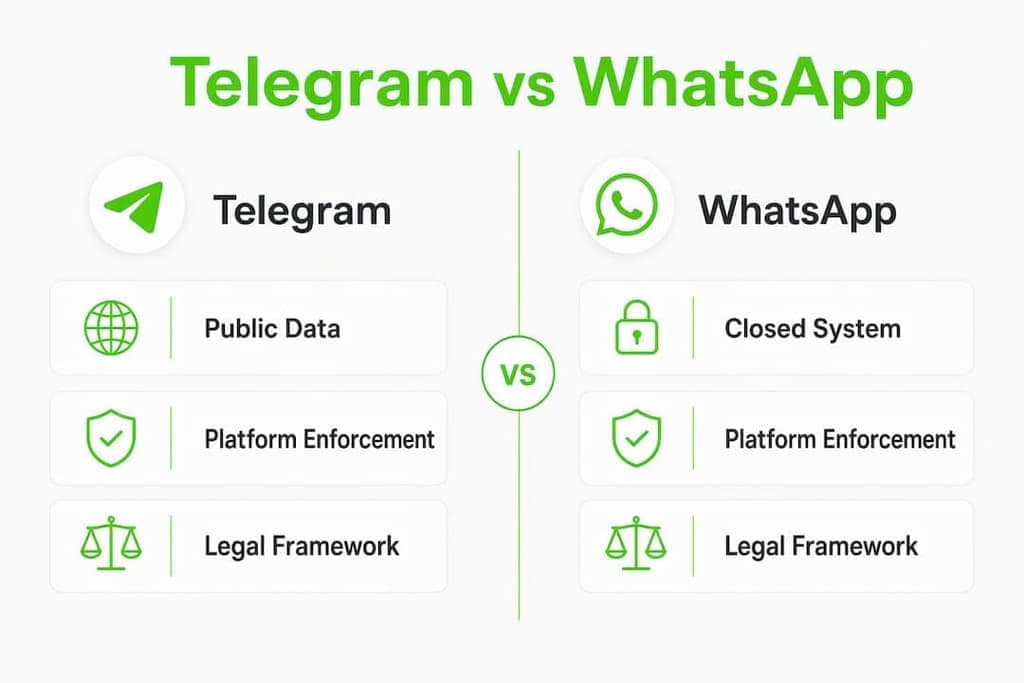
Telegram and WhatsApp operate under the same legal frameworks but with very different technical architectures. That difference changes the practical risk profile significantly.
| Factor | Telegram | |
|---|---|---|
| Public data availability | Public channels and groups are openly accessible | No public channels; all groups require membership |
| Legal scraping baseline | Scraping public channels is generally legal under US law | Scraping is legally higher risk due to closed architecture |
| CFAA exposure | Low for public data, high if authentication is bypassed | Higher baseline due to end-to-end encryption and closed access |
| GDPR applicability | Applies to personal data in all groups | Applies; stricter enforcement given Meta's regulatory history |
| Platform enforcement | FloodWaitErrors and account bans for mass scraping | Aggressive bans; legal action history against scrapers |
The core difference is architecture. Telegram's public group model admits some scraping that WhatsApp's closed system simply does not. WhatsApp scraping carries higher legal and platform risk because there is no equivalent of a public Telegram channel. Every WhatsApp group requires membership, which means every scraping attempt involves authenticated access.
Both platforms apply GDPR and CFAA analysis identically. Both ban accounts for automated extraction at scale. The legal frameworks are the same; the technical exposure is not. If you are asking whether is WhatsApp scraping legal, the short answer is: it depends on the same factors as Telegram, but with fewer situations where public data access is even possible.
Key Takeaways
Telegram scraping is generally legal for public data under US law, but GDPR compliance and platform enforcement create real, separate risks that legal clearance alone does not resolve.
| Point | Details |
|---|---|
| US legal baseline | Scraping public, unauthenticated Telegram data does not violate the CFAA per hiQ and Bright Data rulings. |
| GDPR compliance | Collecting personal data without a valid lawful basis risks fines up to €20 million or 4% of global turnover. |
| Platform enforcement | Telegram permanently bans accounts for mass member list scraping, regardless of legal status. |
| Permission-first approach | Written admin consent and an auditable compliance log are the foundation of defensible data collection. |
| WhatsApp comparison | WhatsApp's closed architecture makes scraping legally riskier than Telegram's public channel model. |
The part most compliance guides skip
I've watched organizations spend weeks analyzing GDPR lawful basis documentation and zero minutes thinking about Telegram's anti-spam engine. That's backwards. In practice, technical enforcement moves faster than legal enforcement. Telegram will ban your account within hours of triggering its detection systems. A GDPR investigation takes months or years. The immediate operational risk is the platform, not the regulator.
That doesn't mean legal compliance is optional. It means you need to treat platform rules and legal rules as parallel obligations, not sequential ones. The organizations that get this right adopt a permission-first model from day one: they scrape their own assets, get written consent for everything else, and build FloodWaitError handling into every script. They don't wait for a ban or a regulatory notice to tighten their practices.
Privacy regulation is also moving in one direction. The EU AI Act, EDPB Opinion 28/2024, and the spread of GDPR-equivalent laws into the UAE, Brazil, and beyond all point toward stricter requirements for automated data collection. What passes legal review today may not pass in 18 months. Building audit-ready data practices now is not overcautious. It is the only sustainable approach.
The teams I've seen succeed long-term are the ones who treat compliance as a workflow, not a checkbox. Document the lawful basis before you collect. Store the admin permission before you run the script. Collect the minimum data that serves your actual use case. That discipline compounds over time into a data operation that can survive regulatory scrutiny and platform policy changes.
Elias
Mastros makes compliant Telegram data extraction practical
Knowing the legal framework is one thing. Having a tool that respects it is another.
Mastros builds a Telegram Scraper Chrome extension that exports group members, chat messages, recent contacts, mutual groups, and bulk media directly from Telegram Web. Everything runs in your browser, so your data never leaves your device. There are no API credentials to create and no second login: the extension reads the Telegram Web session you are already signed into. Mastros also offers a WhatsApp Scraper for exporting group members, messages, and contacts from WhatsApp Web in read-only mode. Both tools export to CSV, JSON, or JSONL, giving you clean, audit-ready files from the start.
FAQ
Is scraping public Telegram channels legal in the US?
Yes. US federal courts, including the Ninth Circuit in hiQ v. LinkedIn and Meta v. Bright Data, hold that scraping publicly accessible, unauthenticated data does not violate the CFAA. Public Telegram channels fall within this legal position.
Does GDPR apply to data scraped from Telegram?
Yes. GDPR applies to any personal data collected from Telegram users in the EU or EEA, regardless of whether the group was public. Collecting that data without a valid lawful basis risks fines up to €20 million or 4% of global annual turnover.
Can Telegram ban my account for scraping even if it's legal?
Yes. Telegram's anti-spam engine monitors scraping patterns and permanently bans accounts engaged in mass member list extraction. Legal status does not protect your account from platform enforcement.
What is the safest way to scrape Telegram data?
The safest approach is to scrape only Telegram assets you own or administer, get written permission from channel admins before accessing external groups, and maintain a documented compliance log with your lawful basis for each collection activity.
Is scraping Telegram messages legal the same as scraping member lists?
No. Message scraping from public channels carries lower platform enforcement risk than member list scraping. Telegram treats mass member extraction with greater scrutiny and responds with more aggressive account bans.
Recommended
- How to Archive Telegram Messages for Compliance: A Practical Guide (Mastros Blog)
- Telegram Scraper Chrome Extension: Members, Messages, Mutual Groups
- LinkedIn Sales Navigator vs Telegram Group Scraping: A Practical Comparison (Mastros Blog)
- Telegram Data Analytics: Tools and Techniques for 2026 (Mastros Blog)