


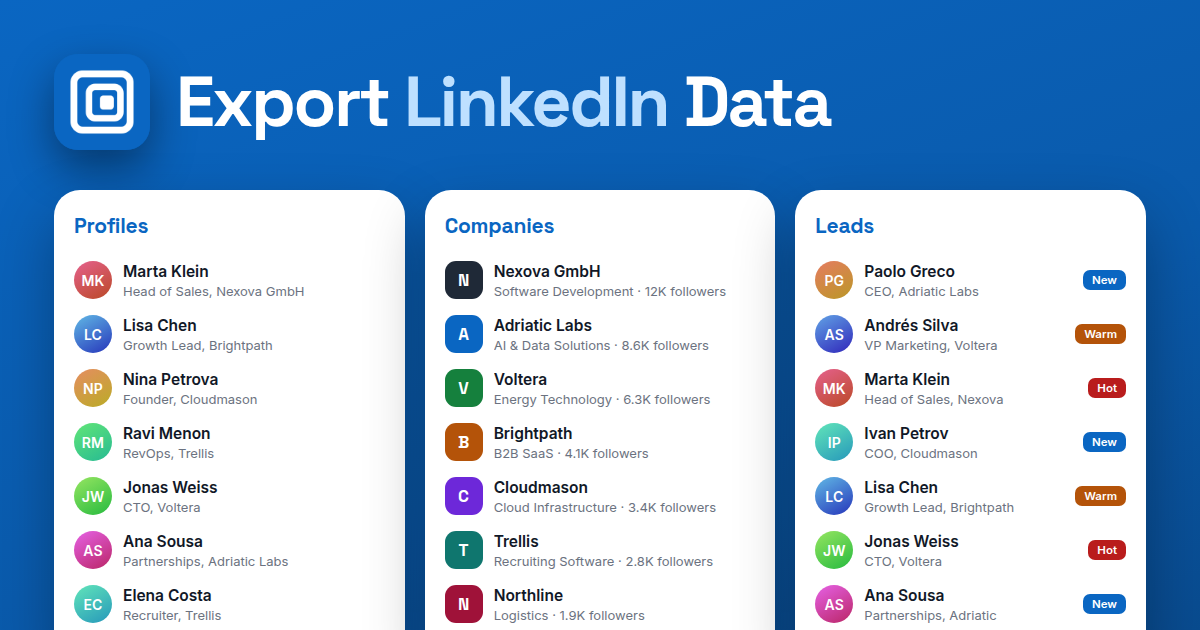
LinkedIn does not show email addresses on profiles, and no browser extension can read what is not there. The method that works at scale has two steps: export the people you want from LinkedIn search or Sales Navigator with the Mastros LinkedIn extension, then run that file through an email enrichment tool that matches each name and company to a verified work address. Mastros does the first step; it does not find, guess or generate emails.
Why can't a LinkedIn scraper find email addresses directly?
A LinkedIn profile shows an email only on the contact-info card, only if the person added one, and only to connections they allowed. For everyone else there is nothing on the page to read. Tools that advertise "LinkedIn email finder" are doing one of two things: querying an external database of work emails and matching it to the name and company, or generating a pattern guess (first.last@company.com) and verifying it against the mail server. Both are enrichment, not extraction, and both work from a clean list of names and companies. That list is the part LinkedIn gives you, and the part Mastros exports.
How do you export the people first?
- Run the search you want in LinkedIn People search or Sales Navigator: title, company, location, keywords. The filters become the shape of your list.
- Open the Mastros extension from the Chrome toolbar and start the search results export.
- Let it page through the results in your browser. You get one row per person with the fields shown in the results, including the profile URL.
- Download as CSV, JSON or JSONL; the CSV opens in Excel and Google Sheets. That file is the input for enrichment.
Keep the search tight. Enrichment tools charge per lookup, so a filtered list of 300 decision-makers costs a fraction of an unfiltered export of 3,000.
Which email enrichment tools work with an exported list?
All of the tools below accept a CSV upload or a spreadsheet integration and return work emails with a confidence or verification flag. Pricing is per credit or per seat and changes often; check each vendor's page before you commit.
| Tool | What it does with your file | Notes |
|---|---|---|
| Hunter | Matches name plus company domain to a known email pattern, verifies the result | Strong on company patterns; needs the company website, which you can add from the company name |
| Apollo | Matches against its own contact database, adds phone and firmographics | Largest database in this group; also a full outreach platform |
| Snov.io | Bulk email search from name and domain, built-in verifier | Cheap entry tier for small lists |
| Lusha | Enriches from a spreadsheet or a Chrome extension | Also returns direct dials where it has them |
| Dropcontact | Finds and verifies from name and company, GDPR-focused | Popular with European teams for that reason |
| Kaspr | Chrome extension and bulk enrichment | Coverage is strongest in Europe |
Expect coverage, not completeness. A good enrichment run returns verified emails for a majority of a B2B list and leaves the rest blank or marked as a guess. Filter out anything below the tool's confidence threshold before you send.
What does the file look like after enrichment?
Your exported columns stay as they were: name, headline, company, location, profile URL. The enrichment tool appends an email column, a status column (verified, risky, not found) and, depending on the tool, a phone column. Keep the profile URL as the key. It is stable, it de-duplicates across runs, and every CRM can map it.
Is finding LinkedIn emails this way legal?
Two different rules apply to the two steps. The export reads pages you can already see in your own logged-in session; Mastros sends nothing, connects with nobody and never runs while you are away, which is the line it holds on every platform. LinkedIn's User Agreement still restricts collecting data with software, so keep the list to people you have a business reason to contact and do not resell it.
Enrichment is governed by data-protection law where you and your contacts are. In the EU and the UK, a work email used for a relevant business message is usually defensible under legitimate interest, but you owe people an easy opt-out and an honest answer about where their data came from. In the US, CAN-SPAM covers the message, not the lookup. If a list is going into a shared CRM, document the source and the basis before it does.
What about Sales Navigator?
The same two steps apply, and the first one is better: Sales Navigator search results and saved lead lists carry richer filters than the free search, and the Mastros export reads them the same way. See Sales Navigator export. Sales Navigator itself does not show emails either; the enrichment step is still needed.
FAQ
Does the Mastros LinkedIn extension find email addresses?
No. It exports the people and their profile data from search results, Sales Navigator and profiles. Emails come from an enrichment tool run on that file.
Can I get emails from LinkedIn's own connections export?
Only for 1st-degree connections who allowed it in their settings, which is a minority. See Export LinkedIn connections to Excel.
Which enrichment tool is most accurate?
It depends on your list's region and industry. Run a sample of 50 rows through two tools and compare verified rates before buying credits.
Do enrichment tools need the company website?
Most match faster with a domain. If your export only has the company name, most tools resolve the domain themselves; Hunter works best when you add it.
How many emails will I get from a list of 1,000?
Vendors quote different rates and lists vary. Test a sample; do not budget on a headline percentage.
Is there a free way to do this?
LinkedIn's connections export is free but nearly emailless. Most enrichment tools have a small free tier good for a test, not a campaign.